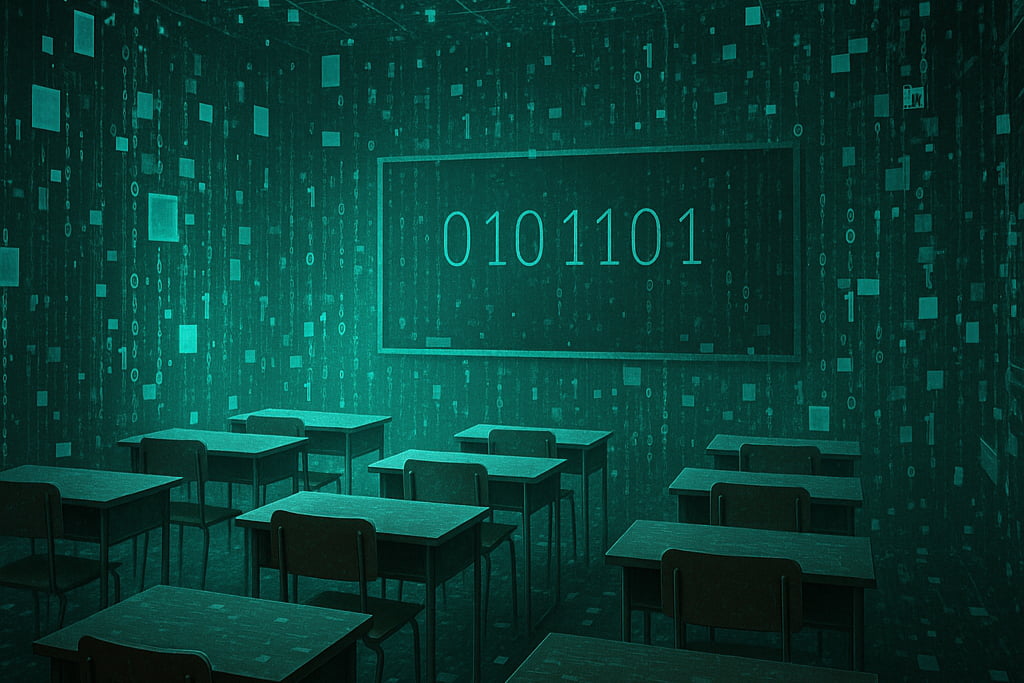
A Thought on the Future of Education
The shortage of teachers is nothing new. For years we have been discussing how to train more educators, only to place them in a system that has hardly changed at its core for decades.
Perhaps we should ask ourselves an uncomfortable question. What if the key is not to bring more people into the old system, but to change the system itself?
Artificial intelligence can already do many things that, until now, only humans could do. It can explain, test, adapt exercises, and measure progress. In the near future, it will be able to do more than we are willing to imagine today:
- Grade fairly and transparently, without human bias or mood swings
- Analyze abilities, strengths, and weaknesses with psychological depth
- Support personal development instead of only testing knowledge
- Mediate between people and detect conflicts before they escalate
- Identify possible problems at home by reading between the lines
What AI cannot do: supervise, comfort, encourage, inspire movement. That is exactly where teachers would have more time, and those are the moments where humans are irreplaceable.
Perhaps the greatest potential lies in the ability to look beyond grades and performance. Not every child with good grades is automatically hardworking or particularly intelligent. And not every child with poor grades is automatically lazy or less gifted. Often it is structures, routines, or simply how well a child fits into the existing system that make the difference.
Today we often realize too late when a student passes but has never truly learned how to learn, or when a quiet student is highly gifted but goes unnoticed. AI could analyze learning behavior, motivation, and comprehension in a depth that is hardly possible for humans. It could help ensure that talents are not overlooked and that children are not placed on the wrong paths.
This is not about replacing teachers. It is about redefining their role: less as transmitters of knowledge, more as mentors, coaches, mediators, and role models.
We are facing an educational shift that is not coming someday in the future. It has already begun. The question is not whether AI will become part of our education system, but how. Will we wait, drift along, or shape it now?
Perhaps it is time not only to ask how well a child fits into school, but also how well school fits each child.
And perhaps we should also ask who this child can become, instead of merely evaluating how well they can learn.
Karina Rose - Welten aus Lego
A door to the outside...
...behind it lies a video, waiting just for you. Whether you want to see it is entirely your choice.