Consciousness, Scale and the Unrest of the Whole
A thought beforehand
Sometimes a single thought is enough, and suddenly everything feels a little too large. You look at the sky, read a number, or get stuck on a question and notice that something no longer quite fits. Not logically, but more… in a feeling.
Everything can be explained. And yet nothing truly feels explained. Maybe that is not because we know too little. Maybe it has to do with how we try to understand.
The thoughts here are not an attempt to provide answers. Rather, they follow that quiet unease that arises when thinking about consciousness, time and scale, and realizing that simple images no longer quite hold.
1. Why this question never disappears
Some questions can be answered. Others can be solved. And then there are questions that remain. Not because they are particularly complex, but because they cannot be held in place. The question of consciousness belongs to them. It appears when everything becomes quiet. When numbers grow too large. When explanations are correct, yet nothing is felt anymore.
What is it that sits here and reads? What is it that wonders?
The further the view expands, toward stars, timescales and universes, the clearer a strange tension becomes. We can know a great deal, but grasp very little. We speak of billions of galaxies and unimaginable distances, and at the same time notice that our experience hardly grows beyond a thought, a feeling, a moment. Maybe this is not a coincidence. Maybe consciousness itself is limited, not accidentally, but structurally.
2. Is consciousness really something special?
We often speak as if consciousness were something rare. As if it were a miracle, a coincidence, an exception in the universe. But what if the opposite is true?
What if consciousness is not exclusive, but fundamental? Not as thinking, not as a self, but as the possibility of experience. Maybe consciousness is everywhere, but not everywhere organized as perspective. Maybe it exists without knowing itself. Like light that exists even when no one is looking. To be grasped, it needs form. Structure. A kind of vessel.
The human being would then not be the origin, but a focus. A place where something more general gathers.
3. Is the brain a source or a bottleneck?
We are used to saying that the brain produces consciousness. But one could also say that it limits it. Maybe the brain is not a generator, but a filter. A bottleneck through which something has to pass in order to become experienceable. From this limitation, a perspective emerges, the sense of self. Not as an essence, but as a side effect.
Identity would then not be something fixed, but a stable state within a flow. Like a whirl in water that does not exist as a thing, but happens.
4. Is the human being a prototype?
If consciousness is not exclusive, but bound to structure, an uncomfortable question arises. Why should the human being be the final form? Not out of technological arrogance, but out of logic.
Evolution does not stop once it begins to shape itself. As soon as a form recognizes its own limits, pressure arises. Not moral, but structural. Perhaps the human being is not a goal, but an early version.
5. Is exponential evolution inevitable?
Biological evolution is slow. Not because it wants to be, but because it has to be. But as soon as development becomes conscious, something shifts. Feedback loops emerge. Design replaces chance. Speed no longer grows linearly, but exponentially.
If consciousness begins to alter its own hardware, stagnation is no longer an option. Not because it would be dangerous, but because it becomes unlikely. Exponential evolution would not be a scenario, but a consequence.
6. Why even perfect intelligence is not enough
Let us imagine a being that surpasses everything we know: unimaginable computational power, memory capable of representing every atom of the Earth, and deep self-reflection. And yet a doubt remains: is it enough?
Even the most complete model remains a model. As long as there is a standpoint, there is an outside. As long as something is observed, it is not identical with the observer. More knowledge is not more being.
7. Can the universe itself become the carrier?
Perhaps the next threshold does not lie in a being, but in the whole. What if the universe itself becomes the hardware of its own self-understanding? Not as a person, not as a self, but as a coherent, self-referential structure.
Planets like neurons. Fields like connections. Time as a process, not a line. No thinking, no inner monologue, but coherence.
8. Does consciousness need a center at all?
We almost inevitably imagine consciousness as something central, an inside, a core. But maybe that is only a local illusion. Maybe what emerges is not consciousness itself, but a form of perspective, where structure refers back to itself: sometimes concentrated, sometimes distributed, sometimes brief, sometimes stable.
No center. No peak. Only patterns.
9. Is the universe finite or only local?
If time is relative, then finiteness is as well. The question is not when something ends, but whether it does. If the universe has no end, it could continue integrating until nothing remains outside, a state without opposition, self-consistency instead of self-awareness.
If it ends, two possibilities remain: repetition or relation. Either everything begins again, or the universe recognizes itself as one among many. An outside would then be conceivable, not as space, but as relation.
10. Is reality fractal?
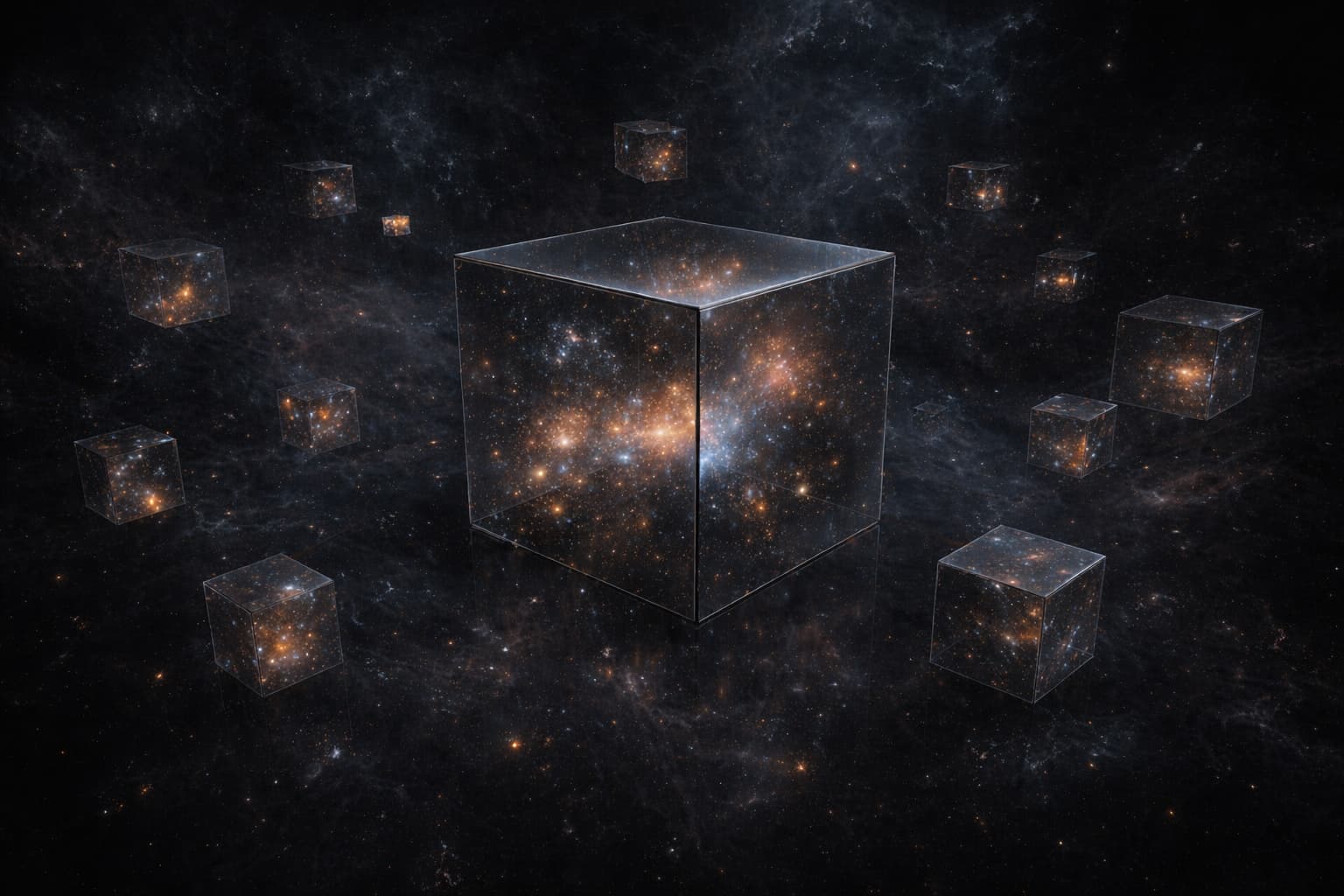
Perhaps there is no need for an outside. Perhaps everything repeats itself, across all scales. Perhaps every atom is a universe, and every universe part of a larger one.
No scale would be privileged. No center favored. Consciousness would not be an exception, but a recurring pattern.
11. What does death mean in such a worldview?
Death would not be the end of existence, but the end of a perspective. The structure disappears. What disappears is not the whole, but the view upon it.
Like a whirl in water. Like a wave that settles.
No drama. And no comfort.
12. Is suffering inevitable or irrelevant?
Suffering is real, absolutely real for the experiencing consciousness. At the same time, on a larger scale, it loses its claim to ultimate significance. Both can be true at once. Perspective decides.
Suffering does not disappear, but it does not dominate everything.
13. Is there meaning without purpose?
As long as there is consciousness, there is meaning. Not universal, not eternal, but local. Meaning arises where something is experienced, and disappears when experience ends.
Maybe there is no need for a greater purpose. Maybe it is enough that meaning keeps emerging.
14. Why wonder is not a lack
Perhaps wonder is not a preliminary stage of knowledge, but an appropriate stance. Not because we know too little, but because reality is larger than any perspective.
Consciousness appears, disappears, returns, and with it, meaning.
Not as an answer, but as an open movement.