A Life That Works on the Outside
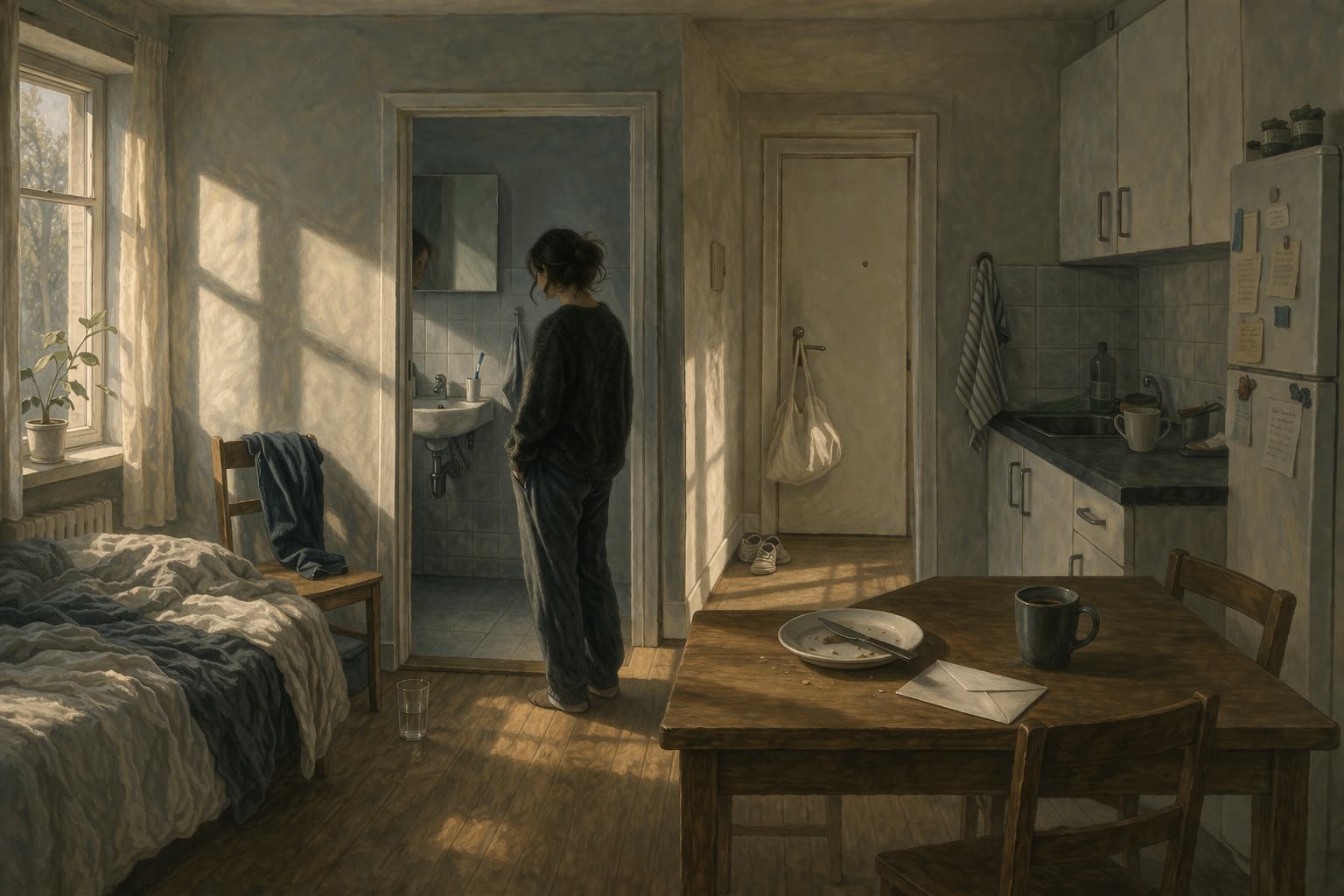
When she opened her eyes, it was already late in the morning. The sun was shining through the window, and under the blanket it was slowly getting too warm. She stayed where she was for another moment and looked toward the door. The trousers from the night before were lying on the chair. A glass with old water stood on the floor. A bag hung from the handle, one she had been meaning to take with her for days. It was not chaos. That was exactly what made it hard to think honestly about it. Nothing in the room was dramatic. Nothing about it would have worried anyone right away. And yet small things were lying around everywhere, or standing around, things that should have been dealt with long ago. She knew at first glance that this day would begin the same way so many others had.
She sat up and stayed sitting. Other people got up and started. For her, even that had never been natural. Eventually she went into the hallway. The apartment was small. You could take it all in at a glance. In the bathroom, the sink with a few too many things on it. In the kitchen, the plate from the night before, the knife next to it, crumbs on the counter. On the table, a letter she had not opened for days. None of it was big. None of it was difficult. That was exactly why it looked so harmless from the outside. She glanced at herself in the mirror and immediately looked away again. Not out of shame. More out of exhaustion at the thought of having to search her own face for an explanation. She looked tired, but not conspicuously so. More like someone who had slept badly or was distracted. Not like someone whose simplest routines had never really worked.
The toothbrush was where it belonged. She did not pick it up. Instead, she let the water run for a moment and then turned it off again. The water worked. The light worked. The day worked. Only she did not. In the kitchen she opened the fridge. There was bread. There was cheese. She could have made herself something to eat in a matter of minutes. She knew that. In fact, she knew a great many things. She could have wiped away the crumbs, put the plate in the sink, opened the letter, and later taken the trash bag out with her. The steps were clear. The problem had never been that she did not know what needed to be done. The problem was that between that knowledge and the action, there was almost always something standing there that she could not explain to herself.
She leaned against the counter and looked at the crumbs. It was always the same. Not just for the past few weeks. Really, it had almost always been this way. Other people would not have made anything special out of walking into the bathroom, going into the kitchen, or reaching for a letter. For her, those were exactly the things where everything already began to stall. She had been living at a minimum for years. Maybe even longer. She did just enough to keep everything from visibly collapsing.
Some things worked. Above all, the things shaped by clear demands from outside. Work. Appointments. Things with a fixed frame. But in her own everyday life, in the apartment, in those quiet hours with no one watching, almost nothing happened on its own. And because it had been that way for so long, she had eventually treated it like an unpleasant trait instead of a real problem.
She made coffee. Not out of determination. More because these small evasive movements were easier than the things that actually needed to be done. While the machine was running, she went back into the room, picked up the trousers from the chair, and put them back down again, just a little more neatly. For a moment she had to laugh. Not out of humor. More out of weariness at the absurdity of herself. She could think. She could work. She could recognize problems. She could carry responsibility. And yet, in her own apartment, she could not manage to properly put away a pair of trousers.
She sat down on the edge of the bed and thought about her work. There, where things were concrete, she always functioned. If something was wrong, she saw it. If something was missing, she added it. And if something did not fit, she changed it. At work, problems had a shape. At home, it was different. Here there was no clear point where she could say: that is the reason. Here there were only small tasks that were objectively simple and still felt as though something invisible stood between her and every action.
It was not that she did not care. That was perhaps the bitterest part of it. She did want things to go better. She did not want a perfect apartment. Not excessive order. Just something normal. An everyday life that did not get stuck on a toothbrush, a plate, a letter, and a trash bag. She did not even want something back. For that, it would have had to have been different before. That was exactly the problem. These simple routines had never really worked for her.
Her gaze moved through the room again. Chair. Glass. Bag. Door. Everything quiet. Everything small. Everything manageable. And yet she had the feeling that in exactly these harmless things there was a judgment about her. Not because she was messy. Not because she knew too little. But because she was beginning to understand more and more clearly that this was not a temporary condition that would somehow sort itself out on its own. It was a pattern. An old one. One that had belonged to her everyday life for so long that only now was she slowly beginning to understand how wrong it actually was. Sometimes she suspected there was more behind it than simple laziness or a bad habit. Something inside her had shifted. Nothing loud. Nothing spectacular. But enough to make even simple things impossible.
She went back into the bathroom one more time and this time picked up the toothbrush. For a brief moment she thought that maybe now it would work after all. But the moment she looked into the mirror, that small beginning collapsed again. Not suddenly. Not dramatically. More as if it had never truly held. She put the toothbrush back down. Then she went into the kitchen again. The plate remained where it was. The letter stayed unopened. The trash bag remained by the door.
Later she sat at the table, the cold cup of coffee in front of her and the letter beside it. She still knew exactly what she should have started with. The order had never been the problem. Slowly she began to understand that this was exactly where the real problem lay. Not that she was failing at something big. But that she had been living for years in a state where even the small things did not function reliably. And that for far too long she had treated it as something one simply had to live with. Maybe that was what was new about this morning. Not the apartment. Not the plate. Not the letter. Only the thought that it could not simply go on like this.